Friday, December 6, 2019

7 Simple Stretches for Older Adults By the Editors of SilverSneakers | September 18, 2019

Need to turn your head to check for traffic, or reach into the cupboard for a plate? Want to improve your golf swing—or your cha-cha? Better flexibility can help with all of those. A more flexible body means you’ll have a greater range of motion in your joints, which makes it easier to move. And if you spend a lot of time sitting or looking at a screen, you’ll want to work the stiffness out of your shoulders, back, and hips. Ready to loosen up? These simple stretches can help.

(full link: https://www.silversneakers.com/blog/stretching-for-seniors-7-simple-moves-for-the-not-so-flexible/)

How to Use These Stretches

These stretches are meant to be versatile, and you should feel free to use them however they best help you. You can pick one or two stretches to do anytime you want to relieve joint stiffness or muscle tension. Or you can do all seven together at the end of your normal workout or on their own as a stretching routine. They’re gentle enough to do every day, if you wish.

Most of these stretches can be done without any equipment and with minimal space, but you can modify them as needed. For example, most of the standing and floor stretches can also be done in a chair. Plus, you’ll see other tips to make the stretches easier.

If performing these stretches as a routine, you’ll want clear space, a mat, and a bench or chair. Get your blood flowing by walking in place for five minutes. Perform each stretch for 10 to 30 seconds, and repeat up to three rounds.

As you stretch, breathe deeply, and go slowly. Listen to your body, and never force a movement that causes pain. It’s okay if you can’t bend very far now. It’s more important to use good form. And with regular stretching, your flexibility will improve.

Here’s how to perform each stretch. As always, safety is key. The stretches here may be different or more advanced than those you’ll experience in a Silver Sneakers class. If you have a chronic condition (including osteoporosis, an injury, or balance issues) talk to your doctor about how you can exercise safely.


1. Overhead Side Stretch


SS_OverheadSideStretch_A0028
Hold for 10 to 30 seconds per side
How to do it: Stand tall with your feet hip-width apart. Raise your arms overhead. If you’d like, interlace your fingers.
Keeping your torso long, gently lean to the left, and hold for 10 to 30 seconds. Return to center, and repeat on the other side.

Make it easier: Sit tall in a chair, keeping your hips, knees, and toes forward. If it’s uncomfortable to lift your arms overhead, rest your arms on your hips, or keep them down by your sides.


2. Shoulder Stretch


SS_ShoulderStretch_A0029
Hold for 10 to 30 seconds per side
How to do it: Stand tall with your feet hip-width apart. Reach your right arm across your body. Place your left hand on your upper right arm, and gently draw your right arm closer. Hold for 10 to 30 seconds. Release, switch arms, and repeat.

Make it easier: Sit tall in a chair, keeping your hips, knees, and toes forward. If this stretch is uncomfortable, try the shoulder roll. It’s a great stretch for your neck and shoulders.


3. Triceps Stretch


SS_TricepsStretch__A0030
Hold for 10 to 30 seconds per side
How to do it: Stand tall with your feet hip-width apart. Raise your arms overhead, and bend your right arm so it’s behind your head. Place your left hand above your right elbow, and gently draw your right arm in. Hold for 10 to 30 seconds. Release, switch arms, and repeat.

Make it easier: Sit tall in a chair, keeping your hips, knees, and toes forward. For a shallower stretch, don’t reach your bottom hand as far. Aim for the back of your head rather than the base of your neck.


4. Hamstring Stretch


SS_HamstringStretch_AARP0133
Hold for 10 to 30 seconds per side
How to do it: Place your right heel on a bench with your leg straight and toes up. Without rounding your lower back, gently hinge forward from your hips until you feel a comfortable stretch. Hold for 10 to 30 seconds. Release, switch legs, and repeat.

Make it easier: Do this stretch while seated in a chair, resting your heel on the floor in front of you.


5. Calf Stretch


SS_CalfStretch_AARP_AUG_A0005
Hold for 10 to 30 seconds per side
How to do it: Stand with your left leg in front and slightly bent, and your right leg straight behind you. If you’d like, perform this move near a wall or counter, holding on for support.
Gently press your right heel into the floor to feel a comfortable stretch. Hold for 10 to 30 seconds. Release, switch legs, and repeat.
Make it easier: Sit in a chair for seated calf stretch. See how in our guide to foot exercises for older adults.


6. Supine Knee to Chest Stretch


SS_SupineKneetoChest_AARP0076_M68
Hold for 10 to 30 seconds per side
How to do it: Lie on a mat with your legs straight. If that’s uncomfortable, bend both knees, and rest your feet on the mat.
Keeping your upper body down, lift your right knee toward your chest as far as comfortable. Gently grasp the back of your thigh to draw your leg closer to your chest. Hold for 10 to 30 seconds. Release, switch legs, and repeat.
To come out of the pose, sit up slowly, gently rolling to your side first if needed. Check that you feel steady before standing up.

Make it easier: Sit in a chair for seated knee to chest. See how in our guide to yoga moves to ease back pain.


7. Cat-Cow Stretch


SS_CatCow_A0012
Alternate for 10 to 30 seconds
How to do it: Start on all fours with your hands below shoulders and knees below hips.
Gently round your back up toward the ceiling (like a cat) while tucking your chin toward your tailbone. Then reverse the movement by arching your back (think about a cow) while lifting your hips and head. Continue alternating for 10 to 30 seconds.

Make it easier: If getting on the floor is uncomfortable, perform seated or standing cat-cow.

Saturday, November 23, 2019

Foot Care Professional

Something came up in class the other day that I wanted to clarify about foot care professionals.

In the United States, medical and surgical care of the feet and ankles are mainly provided by two groups of physicians: orthopedic surgeons and podiatrists. 

In general, an orthopedic surgeon is a Doctor of Medicine that specializes in medical and surgical management of all of the bones and joints of the entire body (global musculoskeletal health). Their training includes medical school, has 5+ years in an orthopedic surgical residency, one or more fellowship years, and board certification.

Podiatry is a branch of medicine devoted to the study, diagnosis, and medical and surgical treatment of the foot, ankle and lower extremity.

To become a Doctor of Podiatric Medicine, a candidate must complete: a Bachelor's Degree, 4+ years in Podiatryt School, 3+ years in a surgical based residency, board certification and licensing. While a Podiatrist might not be an M.D., they are part of the medical community and have surgical training.

Chiropody (from English chiro- for hand and Greek -pody for foot) has both ancient and modern elements in its development. Stemming from an ancient Egyptian art, it was practiced by journeymen at fairs, markets and in the street. In the 1800's in England it became a organized profession, and subsequently evolved into the practice of podiatry (though many countries still use the terms interchangeably). The term chiropody itself came about in the 19th century.

Reflexology is a type of massage that involves applying different amounts of pressure to the feet, hands, and ears, based on a theory that these body parts are connected to certain organs and body systems. It rests on the ancient Chinese belief that qi (vital energy), flows through each person. Stress blocks the flow of qi, and that blockage can cause an imbalance in the body that leads to illness. Reflexology aims to keep qi flowing through the body, keeping it balanced and disease free. 

In Chinese medicine, different body parts correspond with different pressure points on the body. Reflexologists use maps of these points in the feet, hands, and ears to determine where they should apply pressure. They believe their touch sends energy flowing through a person’s body until it reaches the area in need of healing.

Sources:


Regarding Salt, Sodium and your Kidneys (from https://medlineplus.gov/lab-tests/sodium-blood-test/): 
  • Sodium in the diet is an electrolyte (the ion Na+) which is very different from Sodium the metal element (symbol Na). Electrolytes are electrically charged minerals that help maintain fluid levels and the balance of chemicals in your body called acids and bases. Sodium also helps your nerves and muscles work properly.
  • You get most of the sodium you need in your diet. Once your body takes in enough sodium, the kidneys get rid of the rest in your urine. If your sodium blood levels are too high or too low, it may mean that you have a problem with your kidneys, dehydration, or another medical condition.


Saturday, November 9, 2019

The Yoga Lounge

For the past eight years I have been honored to provide volunteer yoga services to the participants of the National Multiple Sclerosis Society Pacific Coast Chapter 50 Mile Challenge Walk. Prior to being their yoga provider I actually walked the challenge from 2004 through 2011. (Full disclosure, in 2009 I did all the fundraising but my OB didn't think it advisable that I walk at 8 months pregnant. Turns out I left the event early to give birth to my son).

The Yoga Lounge, 2019
As the yoga provider I help kick-start the event Friday morning with (humorous) stretching/warm-up during Opening Ceremonies, and Saturday and Sunday mornings I greet the walkers in the breakfast room with foam rollers and tennis balls for self massage and suggestions on chair yoga poses to stretch the quadriceps, hamstrings, back muscles, hips, or whatever else needs a morning wake-up.

Friday and Saturday afternoons I host the BYOM Yoga Lounge, a quiet, prop-equipped room that includes:
  • Yoga mats and blankets
  • Multiple sized bolsters
  • Blocks and straps
  • Stretch bands
  • Chilled golf balls and smaller rubber balls for foot massages
  • Tennis balls and lacrosse balls for larger muscle massage
  • Small foam rollers
  • Aromatherapy mist
  • Quiet music and ambient lighting 
  • Chairs for those not able to get onto the floor
I like to think of the service as yoga "triage." Walkers (and staff and volunteers who have spent up to 12 hours on their feet supporting walkers) come in, let me know what body part/s need soothing, and I try to set them up with yoga poses, restorative or otherwise, that will help to stretch, ease, strengthen, and soothe their body stresses. They can also do their own thing, using the props as needed in a quiet space. I supply aromatherapy mists, body lotions, as well as handmade magnesium chloride muscle rub for soothing aching body parts (click to order this on ETSY https://www.etsy.com/shop/BYOMyoga)

Mg Muscle Rub
For some, just taking off shoes and socks and rubbing the soles of the feet on iced golf balls (spiked with a little essential oil) can be delightful. For others the act of lying horizontal, on a blanket, or a supported bolster with feet down, knees up, can be the low back release that does the trick after pounding the pavement for 20 miles.

Walking 20 miles (or even just being upright all day) can create postural challenges (hunching over). Simply lying supine, with arms overhead and resting on blocks can open the shoulders without causing wear and tear on the shoulder joints (see Constructive Savasana below).

Hips, glutes, hamstrings, and quadriceps also take a beating on long walks, so I have a variety of supported floor based yoga poses I introduce, encouraging everyone to hold for at least three minutes, utilizing long slow breaths to maximize the calming effort for muscle and nervous system relaxation.

Some of my time-tested favorites:

Deer Pose/Lazy Pigeon: Prone, legs bent, bottom leg knee closer to body. Torso can be supported on a bolster. perform on both sides. Similar to Pigeon but far less intense on the lower knee and less stretch on the back leg quad/psoas.

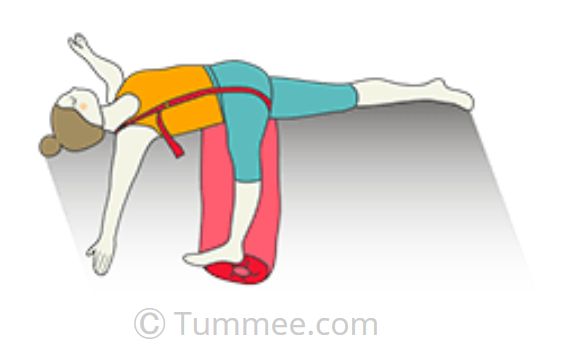
Prone Dancing Shiva/Prone Pavritta Hasta Padagusthasana: Prone extended leg and arm twist. hand and big toe do not have to touch. lower leg extends, body working to "fold" on top of lower leg, pushing through lower heel. bottom hip can be supported (as shown) on block or bolster. restorative version has torso on bolster (not hip). perform on both sides.

Supta Pavritta Hasta Padaghustasana (with props): Supine Twisting Hand to Big Toe Pose has a strap between the hand and top leg that cross over the body, pushing through the heel. upper leg can rest on a bolster/block. Restorative version does not use a strap, or has strap around top thigh and looped around upper arm (see pic). perform on both sides.

Broken Wing/Figure 4: Prone, one leg hiked up to the side at 90 degree like hugging a pillow, ankle below knee. Head turned to one side. release for glutes and outer hip and low bag. Torso can be supported on a bolster. perform on both sides.

Constructive Savasana: Supine, on floor or supported by bolster esp. with low back support. if on bolsters, use additional blocks/blankets under length of arms to prevent hyper-extension of shoulders.

Legs up the Wall/Vipariti Karani: Supine, sit bones at or near wall. bolster under length of body including pelvis and head, or on floor. legs can be gently bound at upper this with strap to support adductors. arms overhead for shoulder stretch or by side, palms open. eye pillow optional. gentle weight/blanket over body or on hips for grounding/low back release optional. gentle weight/blanket on/over feet optional.

Supported Prone Savasana: Prone, bolster/rolled blankets under belly, legs extended at end of bolster or separated to allow knees to descend off sides (similar to frog). arms crossed under head on bolster or floor. rolled blanket under shins for low back support. flesh can be distributed over edge of bottom bolster/between two bolsters for comfort rather than struggle with compression.

Savasana (Restorative): Supine, with bolsters under torso/hips, head, and additional rolled blanket or bolster beneath knees to release low back. arms supports. option to cover eyes, gentle weights/blanket on bellow/hips.

Deer Pose/Lazy Pigeon Prone Dancing Shiva Variation


Revolved Hand to Big Toe Variation Revolved Hand to Big Toe Variation

Legs up the Wall Broken Wing

Prone Savasana Variation 1 Prone Savasana Variation 2

Constructive Savasana


Restorative Savasana Variation Traditional Savasana
If you are looking for a Yoga Lounge provider for your charity event keep BYOMyoga in mind! The NMSS is near and dear to my heart and you'll see me here every year I'm able to provide service. Check the About Me page to see other events at which I volunteer this type of service, or teach Adaptive/Chair yoga classes. Namaste!

Friday, November 1, 2019

New Adaptive Yoga Class starting January 3, 2020

Every Tuesday the Casa de Oro library hosts three Adaptive Yoga classes for Adults with Special Needs at 10am, 11am and noon. The class is open to everyone in the county, whether a client of Regional Center or not. We have regular attendees from St. Madeleine Sophie's Center (who co-sponsors the class), and often have consumers from privte and public programs like Living Independently is for Everyone (LIFE), Stein Education Center, Monte Vista High School, Elite Academy, Unyeway, the ARC, TRACE, and Cool Options to name a few.

I am thrilled to announce that we are starting another class, on Fridays at 10am, to accomodate the enthusiastic attendance, starting January 3. 

The Tuesday 12-12:45 class will no longer meet as of 11/5/2019; we are confident our new Friday class will provide a better opportunity for more people to attend.

As always the class is free, but seats fill up fast so please arrive on time. We have to cap attendance at 25 to ensure the safety and security of everyone; this includes coaches and aides.

The program will be added to the library's calendar by the end of the year. For questions reach out to me at the website email or phone.

Thursday, October 24, 2019

Childhood Anxiety - personal share and advice from friends, therapists, and therapist friends

The Story:

My son had an anxiety meltdown this morning because we had an orthodontist appointment and he was an hour late to school. He didn’t like the idea of coming into class late. We tried soft talking but he absolutely refused to do deep breathing with me; I tried quiet reasoning & I tried to tell him to imagine how happy his friends would be to see him and I told him I’d walk him into Class. He curled himself into a ball in the school office and wouldn’t relax and regressed into a little boy reaching for the door and whimpering to be taken home.

He wasn’t in any pain he did say that he was a little bit tired I had given him children’s Advil because his teeth hurt a little bit. He hates to be late anywhere & we do our best to make sure that he’s on time but whenever he’s even two minutes late he throws his hands in the air and says it’s not even worth going, so this morning’s hour behind schedule really threw him for a loop.

I tried rubbing his back and softly reminding him that going home wasn’t an option, so he needed to take some deep slow breath‘s until the part of his brain that was worried could let the calm 10 year old part of his brain take over. But I could see in his face that he absolutely wanted to stick with being upset.

As much as I understand that he wanted to be rescued from the situation I also knew that he needed to find a way out of it on his own. the woman in the office eventually came to get him and took him to the nurses station where he could gather his thoughts; he clung to my arms as she walked him away and he started to cry so with my heart breaking I told him I was proud of him and I knew he could be do it and he’d be OK and I’d see him at pick up time.

This happens once in a while when he’s tired and somehow gets it in his mind that he’s going to have a meltdown and I’m going to give in and let him stay home from school. I told him at the beginning of the year that we were going to work really hard to not have days like that because we did it quite a few times last year and he was a little bit older now and we were going to work on him getting through that anxiety. he uses language about it that shows he understands what’s going on and I’m not sure if he’s exploiting it or simply putting words to help explain it to me.

I’m looking for some suggestions to help me find a way to help him work through it so I don’t have to take him off campus? he can always take some time for himself there. I believe in mental health days but I think it’s important that he finds ways to work through this kind of anxiety then just always collapse into a heap and expect mom to rescue him. in the past as soon as I’ve said OK we stay home from school he’s back to normal and wants to play on the computer, Run and jump and socialize so I know it’s just that walking to class and getting through the door that creates the stress.

Short story long maybe I need an appointment with the child psychologist for some skilled advice? 

The (amazing) responses:

1) I’m sorry that happened for both of you. Your instincts and intuition sound right on the mark to me. Some training specifically for emotion regulation for him, when his brain is getting hijacked would be helpful, in addition to the breathing that you wisely suggested. I’m not sure whether Lorraine Hobbs is in San Diego right now, but if she is, I’d recommend giving her a call. She was one of the therapists that adapted the Mindful Self Compassion course curriculum for the teenage brain. She also has expertise with younger kids. From my general common experience, I imagine trying different objects, like a favorite stone, or something to hold, to ground him in his body. Then the soles of his feet, then his breathing. Poor sweetheart, anxiety is a bitch. But the resilience he is building by figuring out he can let it move through him and function where he is supposed to be is invaluable. You don’t want the pattern of anxiety to getting out of the situation by going home to get repeated and repeated, laying down that neural path. All your yoga training is a gift for both of you. I hope you give yourself a lot of love today. It’s so tough being a mom.

2) I have never been a 10 year old boy, but I have had similar anxiety, about being late. For me it was not exactly about the idea of being late, but rather being so conspicuously the center of attention on arrival. It was socially based. There were many times I managed to stay home, play sick and fool my parents starting at an early age. It is in our nature to avoid unpleasant sensations.That being said, I always think it’s a good idea to seek a professional point of view where kids are concerned, as long at it doesn’t just end in a prescription. This also being said by a kidless person.

3)  I can relate to this hard enough to hurt. I had two years of one of my children not being able to get out of the car for school without crying. It was insanely stressful for both of us. I often arrived at work crying. We ended up with two things that helped. (And I realize this isn't the same exactly as the anxiety for being late...ours was a general daily thing). We came up with a routine in the car to look at images on my phone together of the child's choice .... Mt. Everest and lowriders. Lol. Then, I had enlisted the help of the school psychologist and my child was allowed to go to her office first. Sit. Chat. Relax. Focus. Without me. It worked eventually. XO

4) As a school nurse I saw several students over the years with this type of social anxiety. I created a chillax space in my office where kids can come and just “be” until they could relax enough to try some calming down methods. When a person is in the middle of an anxiety attack, it is sometimes impossible to attempt deep breaths etc. I know, because I have an anxiety disorder (which is now controlled through medication, and, no I am not suggesting medicating your son). I didn’t start meds until I was 60.

5) 
6)  I suggest a orienting approach, might be able to practice it as a game. It's a little like the post above mine, but in contrast I would say do not coach the breathing. For me and others, trying to focus on breath increases anxiety

7) That's a bummer. In my experience, I would say the best strategy is to have a little check in with the teachers (and if he has one, a school counselor). This would give him the sense of security knowing that there is a team, working together to support emotional regulation issues.

8) Very common problem with many people and children! CBT is proven to be very effective, but not a quick fix by any means. http://www.cw.bc.ca/library/pdf/pamphlets/Mighty%20Moe1.pdf and https://childmind.org/.../behavioral-treatment-kids.../amp/

9) Social stories with the support of a social worker or psychologist could help with coping strategies. Hugs

10) Does he see the school psychologist? This can be a big help. Not only can work with him on strategies, recognizing and coping with feelings, but it helps the child to know they have someone safe and supportive at the school when these things come up.

11)  There are a lot of great suggestions in these posts. First, kudos to you for holding your ground but in a supportive way. I’m sure it was hard. I like “How to Prevent Anxiety Attacks” post. Another program or concept is the “Zones of Regulation” by Leah Kuypers. Also, nothing wrong with getting advice from the school psych, social worker or counselor.

12) You did everything right IMO. I think it’s good to reinforce it’s okay to do things even when we are upset or anxious. That it might turn out okay if we don’t retreat, hide, or avoid. That life is about feeling those feelings and still moving forward. The day might get better, stay the same, or sometime get worse. But it’s just a day, just a moment, just a very strong wave of emotion. It’s possible to move forward and completely feel like you dont want to or can’t. This is what I wish I had been taught. That my emotions were a) okay and valid b) that I could still do the hard thing.